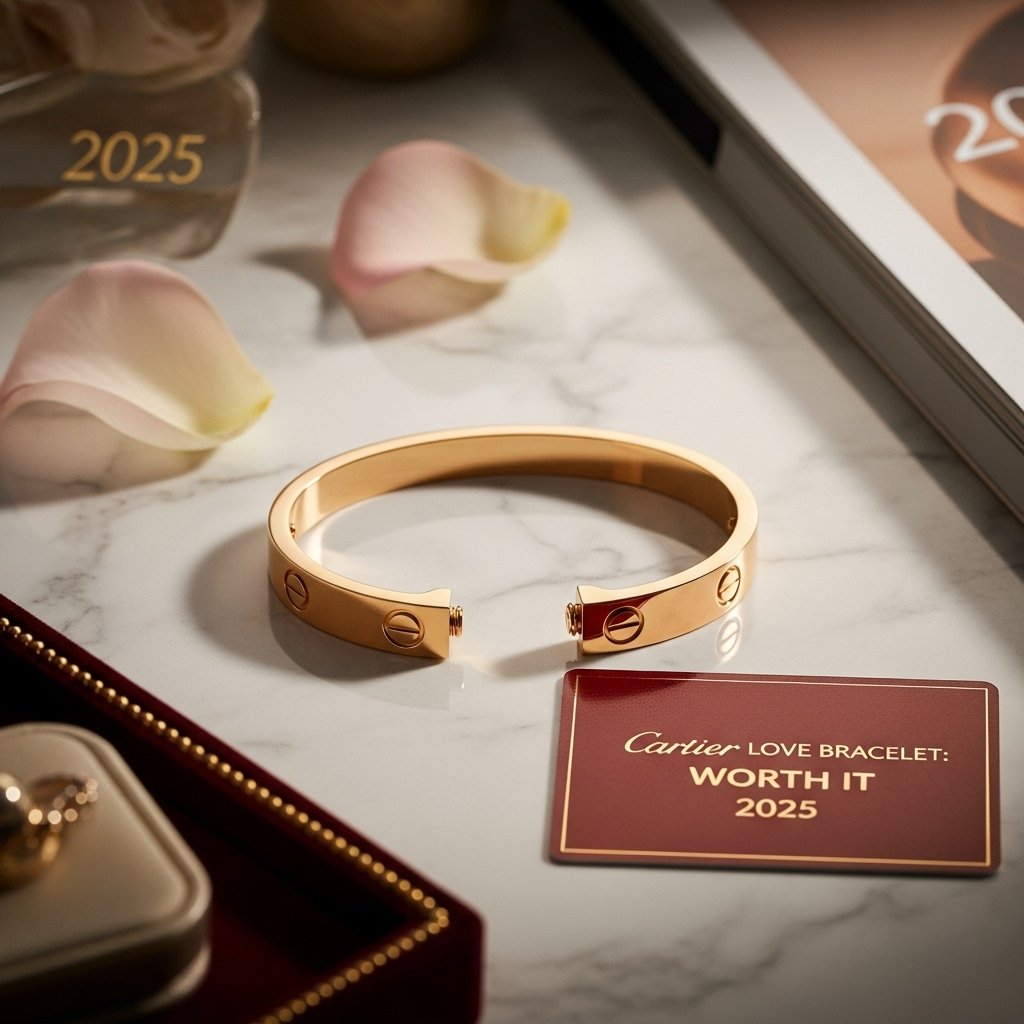
The Cartier Love Bracelet will lose 30% of its value the moment you walk out of the boutique. Let’s be brutally clear: while Van Cleef Alhambra retains 86% resale value and moves in 30 days, the Love Bracelet hovers around 70% retention and sits on secondary markets for 60-90 days. But here’s the twist—certain vintage and limited editions flip the script entirely, appreciating 100-200% over decades. So is the $7,350 classic yellow gold bracelet “worth it” in 2025? Depends on whether you’re buying love or buying equity.
The 70% Reality Check: What Cartier Won’t Advertise
Cartier moved €15.3 billion in jewelry sales for Richemont Group in 2024-2025, an 8% increase year-over-year. They’re printing money. You, however, are not. The Love Bracelet’s resale performance trails every major luxury jewelry competitor except Tiffany.
Plain Gold Bracelets: The $4,500-$5,000 Ceiling
A classic yellow gold Love Bracelet retails for $7,350 in the US as of December 2025. On The RealReal, authenticated pre-owned versions sell for $4,800-$5,200. That’s a $2,000-$2,500 haircut, or roughly 30-35% depreciation. TrueFacet’s market analysis confirms this: expect 65-75% of retail on plain gold models, with 70% being the median.
Why? Oversaturation. Hundreds of Love Bracelets flood resale platforms at any moment. When supply crushes demand, sellers compete by slashing prices.
Diamond Versions Lose Even More
Counterintuitive, right? The 4-diamond classic model retails for $12,700 but resells around $8,500-$9,500. Full diamond pavé pieces fare slightly better (75-80% retention) due to smaller supply, but you’re still losing $3,000+ instantly. Diamonds don’t save you here—they magnify the loss because buyers question authenticity more aggressively, slowing sell-through.
Why Van Cleef Beats Cartier by 16%
Rebag’s 2025 report is damning: Van Cleef averages 86% resale retention globally versus Cartier’s 70%. That 16-point gap translates to thousands of dollars on identical $10K purchases. Van Cleef’s Alhambra collection maintains mystique through controlled distribution and lower secondary market volumes. Cartier? They’ve sold millions of Love Bracelets since 1969, creating a resale glut.
The Abundance Problem: Too Many Love Bracelets, Not Enough Buyers
Scarcity drives luxury. Ubiquity kills it.
The Love Bracelet became the victim of its own success. Every influencer, every anniversary gift, every “treat yourself” splurge involves that iconic screw motif. Result? The RealReal lists 200+ Love Bracelets simultaneously, with more arriving daily. Fashionphile and Rebag mirror this inventory bloat.
Sell-through time averages 45-60 days for plain gold models, stretching to 90+ days if priced optimistically. Compare this to Alhambra’s 30-day average, and you see the liquidity crisis. Buyers know they can wait for a better deal, so sellers capitulate.
Full authentication (serial number verification, hallmark inspection, weight testing) is non-negotiable, but even authenticated pieces sit longer than other luxury jewelry because the market is saturated.
When the Love Bracelet Actually Makes Financial Sense
Stop. Before you write off Cartier entirely, understand the exceptions that prove the rule.
Vintage 1970s-1980s Pieces = 100-200% Appreciation
Original Love Bracelets from the Aldo Cipullo era (1969-1984) trade at $5,500-$39,850 on 1stDibs, with average sales around $5,500 for basic models. But rare variants with original hallmarks, unpolished patina, and provenance? Those hit $15K-$40K at auction. A 1970s bracelet that retailed for $250 now fetches 20-150x its original price.
Collectors pay premiums for early production runs because Cartier changed manufacturing details over decades (screw shape, hallmark placement, gold composition on earliest versions). If you inherit one, don’t polish it—original condition commands top dollar.
Limited Editions & Discontinued Models
Cartier occasionally releases Love Bracelets in unusual materials or with special engravings (celebrity collabs, anniversary editions). These appreciate 15-40% if you can resist wearing them. The 2017 ceramic inlay versions, for example, now resell above retail because Cartier discontinued them.
But you’re gambling. Not every “limited” release becomes collectible.
High-Diamond Pavé: The £20-50K Exception
Full diamond pavé Love Bracelets in the $30K-$50K retail range retain 75-85% because the buyer pool is tiny and discerning. These aren’t impulse purchases—they’re wealth statements. Secondary market buyers at this tier care less about “deals” and more about immediate availability without boutique waitlists.
Material Matters: Rose Gold vs. Yellow Gold Resale
Gold color isn’t just aesthetic—it’s financial.
Yellow gold dominates resale at 70-75% retention because it’s timeless and gender-neutral. Buyers trust it. Rose gold retains 65-70% due to narrower appeal (trendier, more feminine-coded), though demand has grown since 2020. White gold performs worst at 60-68% because it scratches visibly, looks similar to cheaper metals, and appeals to the smallest audience.
Gold price fluctuations directly impact your bracelet’s melt value floor. With gold hitting record highs in 2024-2025 (up 30% since 2020), even heavily worn Love Bracelets hold intrinsic scrap value of $3,500-$4,200 for classic models. That’s your worst-case baseline.
The Hidden Costs They Don’t Mention at the Boutique
You paid $7,350. Congrats. Now budget another $1,500+ over five years.
The Screwdriver You’ll Lose
Cartier includes a proprietary screwdriver with every Love Bracelet. Lose it? $150 replacement fee at boutiques. And you’ll need help every time you want to remove the bracelet because the screw design requires two hands. That “romantic permanence” becomes a logistics nightmare during airport security, medical appointments, or spontaneous outfit changes.
Scratches Tank Value Fast
Soft 18k gold scratches if you look at it wrong. Laptop keyboards, car doors, desk edges—everything leaves marks. Heavy scratching can drop resale value by 10-20% because polishing alters dimensions and removes gold. Cartier charges $200-$400 for professional polishing, but collectors avoid over-polished pieces.
Insurance Premiums for $6,900+ Jewelry
Annual jewelry insurance runs 1-2% of appraised value. That’s $70-$150/year for a classic Love Bracelet, or $700-$1,500 over a decade. Factor this into your “investment” calculation.
2025 Price Increases: Buying Before the Hike
Cartier implemented a May 2025 price increase ranging from 3-8% across collections, though classic Love Bracelets remained unchanged at $7,350 US and €7,950 EU. Richemont Group’s strategy involves annual hikes tied to gold prices (up 30% since 2020) and artificial scarcity maintenance.
Small Love Bracelets jumped from $4,750 to $4,950 (+4.2%), while diamond-pavé rings saw 8-9% increases. The pattern is clear: Cartier raises prices 3-7% annually, meaning a $7,350 bracelet in 2025 will hit $8,000-$8,500 by 2027.
Pre-increase purchases lock “instant equity” only if you’re buying vintage or limited editions. For mass-produced classics, the price hike just means your depreciation starts from a higher number.
Resale Reality: Where Love Bracelets Actually Sell
You’re ready to sell. Where do you go that won’t rob you blind?
The RealReal, Fashionphile, Rebag
These authenticated platforms confirm the 70% retention rule across thousands of transactions. The RealReal lists Love Bracelets at 65-75% of current retail, taking 15-20% commission. Fashionphile offers similar rates but moves inventory slightly faster due to aggressive email marketing. Rebag provides instant quotes (usually 60-70%) or higher consignment percentages if you wait.
Original box, papers, and screwdriver add 15-25% to sale price because they ease buyer anxiety. A $7,350 bracelet with full packaging sells for $5,200; without, it fetches $4,200.
Direct Buyers vs. Consignment
Need cash today? Direct jewelry buyers (local or online) offer 60-65% of resale value immediately. That’s $4,400-$4,800 for a classic bracelet. Consignment platforms get you 70-75% but require 30-90 day waits. Choose speed or money—you don’t get both.
Original Box & Papers Add 15-25%
Can’t stress this enough: that pink Cartier box isn’t trash. Authentication becomes exponentially harder without serial-matched papers, scaring off buyers and tanking prices. Store everything. Photograph everything. Your resale value depends on it.
Cartier vs. Van Cleef: The Investment Verdict
Let’s settle this with math, not marketing.
Van Cleef Alhambra: 86% retention, 30-day average sell-through, appreciation potential on vintage/limited editions, controlled supply. Cartier Love: 70% retention, 60-90 day sell-through, appreciation only on pre-1990 vintage or rare limited editions, oversaturated market.
Van Cleef wins on pure ROI. But Cartier wins on emotional value and cultural iconography. The Love Bracelet represents something beyond jewelry—it’s a relationship symbol, a status signifier, a pop culture artifact. You can’t quantify that in resale percentages.
So is it “worth it”? If you’re buying for love (lowercase), yes. If you’re buying for investment, buy Van Cleef instead.
FAQ
Is the Cartier Love Bracelet worth it in 2025?
Financially, no—it retains only 70% resale value versus competitors like Van Cleef at 86%. However, vintage models (1970s-1980s) have appreciated 100-200% over decades.
How much can I sell my Cartier Love Bracelet for?
Classic yellow gold models resell for $4,800-$5,200 (65-75% of $7,350 retail), with original box and papers adding 15-25%.
Does the Love Bracelet hold value better than other luxury jewelry?
No. It trails Van Cleef (86%), Hermès, and most limited-production luxury pieces, performing similarly to Tiffany (70-75%).
What’s the best time to sell a Cartier Love Bracelet?
Before Cartier announces price increases (typically May annually), as pre-owned prices rise slightly to reflect new retail benchmarks.
Should I buy Cartier or Van Cleef for investment?
Van Cleef Alhambra retains 16% more value and sells 30-60 days faster, making it the superior financial investment.
References
https://sellusyourjewelry.com/blog/locked-in-value-predicting-cartier-love-bracelet-resale-trends-for-2025/
https://www.truefacet.com/guide/much-cartier-love-bracelet-worth/
https://fromluxewithlove.com/cartier-love-bracelet-review/
https://sellusyourjewelry.com/blog/cartier-love-bracelet-market-trends-what-sellers-need-to-know-for-2025/
https://signofthetimeslondon.com/blogs/sign-talk/is-the-cartier-love-bracelet-worth-the-price
https://sellusyourjewelry.com/blog/locked-in-value-cartier-love-bracelet-market-analysis-and-selling-guide-for-2025/
https://www.reddit.com/r/Cartier/comments/13j4d9n/do_cartier_love_bracelets_hold_their_value/
https://loveluxury.co.uk/topics/sell-my-cartier-love-bracelet/
https://loveluxury.ae/blogs/topics/van-cleef-vs-cartier
https://www.pursebop.com/cartier-2025-price-increase-incoming/
https://www.1stdibs.com/buy/1970s-cartier-love-bracelet/
https://58facettes.com/blogs/magazine/2025-augmentation-des-prix-chez-cartier
https://luxuryhedge.com/en-au/cartier-price-increase-may-2025/