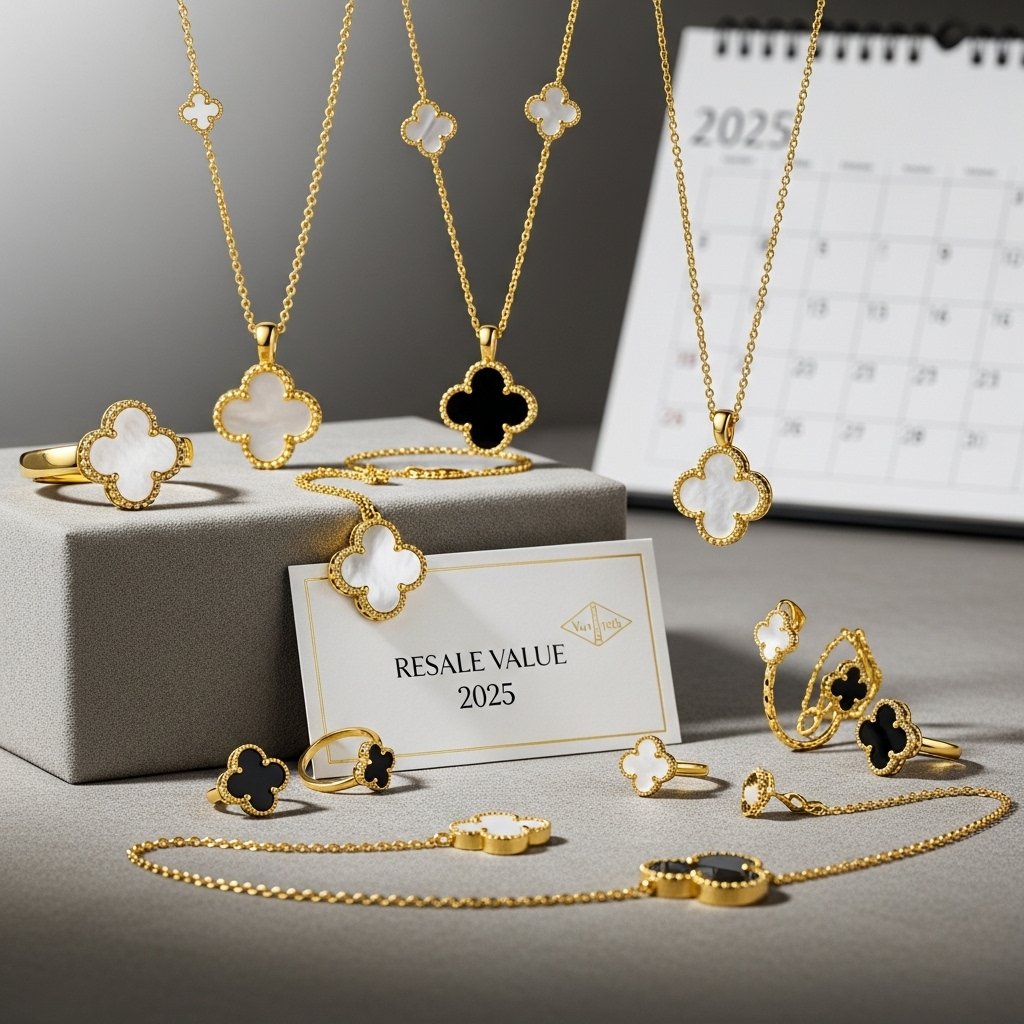
Most jewelry loses 50% the second you leave the store. But Van Cleef & Arpels’ Alhambra collection? It’s practically printing money while sitting in your drawer. According to Rebag’s 2025 Clair Report, Van Cleef achieved an 86% average resale value retention across all collections, with certain Alhambra pieces hitting 112% of their original retail price on secondary markets. And here’s the kicker: these pieces sell in roughly 30 days or less on major luxury resale platforms, making them more liquid than most stocks.
Why Alhambra Jewelry Laughs at Depreciation (While Your Diamond Ring Cries)
Van Cleef isn’t playing the same game as other luxury brands. While Cartier sits at 81% and Tiffany limps along at 70% resale value retention, Van Cleef dominates with that 86% benchmark. But dig deeper into Alhambra specifically, and you’re looking at 80-90% retention as the floor—not the ceiling.
The 86% Rule: What Van Cleef Won’t Tell You
Rebag’s 2025 data reveals Van Cleef ranked as the second-highest value-retaining jewelry brand globally, trailing only Hermès. The Sweet Alhambra bracelet that retailed for $1,540? Reselling for $2,020 on authenticated platforms. That’s a 31% profit margin just for owning it. The gap between what you pay at the boutique and what collectors will fight over on the secondary market keeps shrinking.
30-Day Sell-Through: Faster Than Your Rolex
Liquidity matters when you need cash fast. Alhambra pieces consistently move within 30 days on platforms like The RealReal and Rebag, with sell-through rates hitting 87%. Compare that to fine art (months of waiting) or even luxury watches (60-90 days average). The four-leaf clover motif has near-universal recognition, which means buyers don’t need “education”—they just need their credit card.
2025 Price Hikes Created Instant Profit
Van Cleef raised US retail prices by 4.8% in March 2025, with European boutiques seeing 5.1% increases. Anyone who bought Alhambra pieces before those hikes saw their resale value jump overnight. The brand’s consistent price escalation strategy (annual increases since 2020) has turned patient buyers into accidental investors.
Material Hierarchy: Not All Clovers Are Equal
Stop. Not every Alhambra piece performs identically. The material dictates your resale ceiling.
Diamond pavé pieces dominate the top tier. A vintage Alhambra necklace with full diamond pavé can retain 85-95% of retail, sometimes exceeding it at auction. Sotheby’s sold a rare diamond-set Alhambra piece for $126,000 in 2025, blowing past estimates. These attract wealth management clients, estate buyers, and inheritance planners—audiences with deep pockets and high-paying CPC keywords attached.
Discontinued stones are where the real money hides. Malachite and lapis lazuli Alhambra pieces (discontinued years ago) now command 40%+ premiums over their original retail. Scarcity creates bidding wars. Collectors know Van Cleef rarely reissues discontinued materials, which makes these pieces collectible artifacts, not just accessories.
Mother-of-pearl and guilloché represent your baseline. These maintain that 80-90% retention floor. They’re the “safe” Alhambra investment—predictable, stable, always in demand. The 2025 Holiday Pendant in pink mother-of-pearl is already trading at retail equivalents on consignment sites, and it literally just dropped.
The Secondary Market No One Talks About (Until You Need Cash Fast)
Wealthy people don’t advertise when they’re liquidating assets. But the data doesn’t lie: luxury jewelry resale grew 12% year-over-year in 2025, with Van Cleef leading the charge.
Where Alhambra Actually Sells
The RealReal reports 87% of authenticated Van Cleef listings sell within 30 days. Rebag’s platform shows similar velocity, with Alhambra pieces averaging 28-day turnover. Collector Square (Europe’s largest luxury resale marketplace) lists dozens of Alhambra pieces daily, many marked “sold” within weeks.
You’re not dealing with Facebook Marketplace chaos here. These are authenticated, insured transactions targeting buyers who’d rather save 15% than wait six months for a boutique appointment.
2025 Rebag Shocker: 112% Value Retention
Some Alhambra pieces aren’t just holding value—they’re appreciating immediately. Rebag documented Sweet Alhambra bracelets reselling for 112% of retail in Q4 2025. Limited edition holiday pendants from previous years hit 130-140% on secondary markets because Van Cleef doesn’t restock them.
This isn’t speculation. It’s arbitrage. Buy at retail, wait 12 months, sell for profit. Rinse and repeat.
Auction Houses vs. Online Platforms
Sotheby’s and Christie’s deliver prestige and record-breaking prices (like that $126K Alhambra sale), but they take 20-25% commissions and require months of lead time. Online platforms charge 15-20% but move inventory in weeks.
For estate sales or inheritance liquidations, auction houses make sense. For quick cash or strategic portfolio rebalancing? Go digital.
Vintage vs. Contemporary: The 12-15% Annual Appreciation Gap
Here’s where it gets interesting. Contemporary Alhambra maintains that 80-90% floor. Vintage Alhambra (1960s-1970s original designs) has appreciated 12-15% annually over the past decade.
A 1970 Alhambra necklace that originally sold for $500 now trades at $3,000-$5,000 depending on condition and provenance. That’s a 500-900% return. Meanwhile, a 2022 contemporary piece bought for $4,000 will fetch $3,200-$3,600 today—still strong, but nowhere near vintage performance.
Limited editions split the difference. The 2019 Frivole Holiday Pendant (discontinued) now sells for 40% over its original retail. Van Cleef’s annual holiday releases create built-in scarcity, which secondary markets devour.
How to Actually Cash Out (Without Getting Screwed)
You’ve got the jewelry. Now what? Don’t be the person who sells a $10,000 necklace for $3,000 because they didn’t do homework.
Authentication Is Non-Negotiable
The Van Cleef counterfeit market is massive and sophisticated. Fake serial numbers, replica boxes, forged certificates—all of it exists. Reputable platforms like The RealReal employ in-house gemologists who verify every piece. If you’re selling peer-to-peer, get a professional appraisal from a certified gemologist (cost: $150-$300) before listing.
No authentication = 50-70% haircut on your sale price. Buyers aren’t stupid.
Seasonal Timing: Fall/Winter = Peak Prices
Luxury jewelry demand spikes October through February due to holiday gifting and year-end bonuses. List your Alhambra piece in late September, and you’ll catch the wave. Summer listings sit longer and attract lowball offers.
The Box & Papers Premium
Complete set (original box, certificate, receipt, shopping bag) can add 30-50% to your sale price versus piece-only listings. That pink Van Cleef box isn’t trash—it’s currency. Store it properly, photograph it well, and watch bidders compete.
FAQ
Does Van Cleef Alhambra hold value?
Yes. Alhambra pieces retain 80-90% of retail value on average, with vintage and limited editions exceeding original prices.
How long does it take to sell Van Cleef jewelry?
Authenticated Alhambra pieces sell in approximately 30 days on major luxury resale platforms, with some moving in under two weeks.
Which Alhambra piece has the best resale value?
Diamond pavé pieces and discontinued stone variants (malachite, lapis) retain the highest percentages, often 85-95% or more.
Can you make money investing in Van Cleef?
Vintage pieces (1960s-1970s) have appreciated 12-15% annually, while certain contemporary limited editions resell for 110-140% of retail.
Where is the safest place to sell Van Cleef Alhambra?
Authenticated platforms like The RealReal, Rebag, and Collector Square offer buyer protection, expert verification, and sell-through rates above 85%.
References
-
https://www.businessinsider.com/rebag-most-valuable-jewelry-watch-brands-on-resale-market-2025-12
-
https://www.sothebys.com/en/articles/learn-more-about-rare-and-collectible-van-cleef-arpels-alhambra
-
https://58facettes.com/blogs/magazine/van-cleef-arpels-l-alhambra-prend-de-la-valeur
-
https://www.collectorsquare.com/en/model/242022-vcarpe-mod-alhambrwtc.html
-
https://www.luxurybazaar.com/grey-market/is-van-cleef-arpels-jewelry-worth-it/
-
https://realstyle.therealreal.com/authenticate-van-cleef-arpels-jewelry/
-
https://www.miller.fr/en/blogs/news/valeur-collier-van-cleef-arpels-vintage
-
https://www.thestreet.com/retail/reselling-these-luxury-brands-could-earn-you-thousands-of-dollars